5 Tips for a Stellar Maui Stargazing Adventure
Living here on Maui, I've spent countless nights under some of the darkest, clearest skies on Earth. Hawaii's remote location in the middle of the Pacific Ocean means minimal light pollution, and Maui's volcanic peaks put you literally above the clouds for stargazing that rivals the world's best observatories.
Whether I'm photographing the Milky Way rising over Secret Beach in Makena or watching meteor showers from Haleakalā summit, the night sky here never stops amazing me!
Maui offers some of the best stargazing conditions in the world, and you don't need to be an astronomer or own expensive equipment to experience it.
If you'd like to experience the best possible stargazing, here are five tips I've learned from years of photographing Maui after dark.
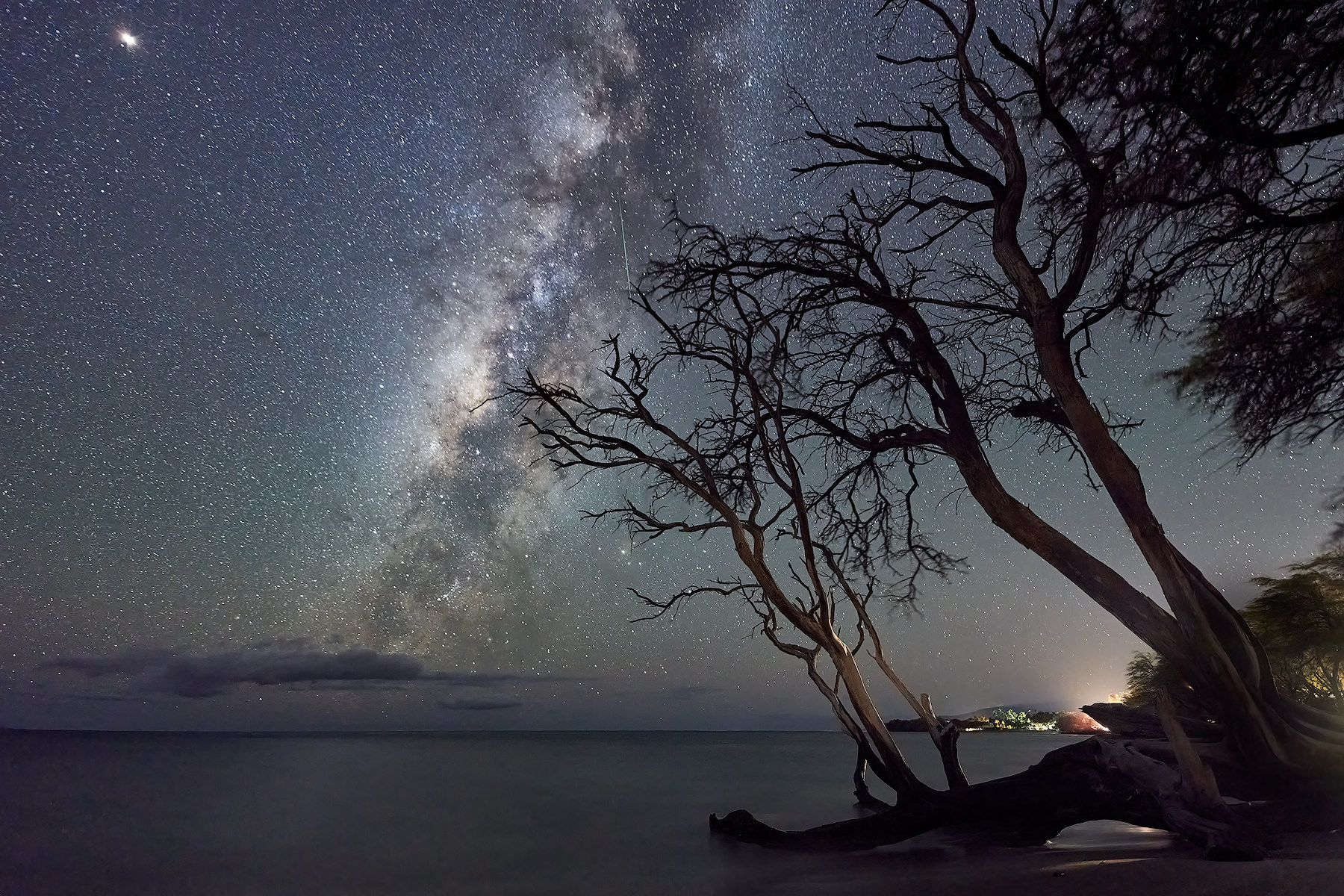
The core of the Milky Way galaxy makes it's way across the Maui night sky. This was during a meteor shower and if you look close, you can see the meteor making it's way through Earth's atmosphere as a green streak. Hawaii has some of the best skies on the planet due to it's remote location in the Pacific and seeing the galaxy with the naked eye makes you feel rather small but a reminder that we're all one.
Collector's Edition of 100
Maui Stargazing Tips at a Glance
- Best Months for Milky Way: April–August
- Clearest Skies Overall: December–February
- Top Location: Haleakalā Summit (10,023 ft)
- Lighting Tip: Avoid full moon nights for best visibility
- Best Months for Meteor Showers: August and December
- Come prepared: Warm clothes, blankets, charged phone & astronomy app.
Tip #1: Timing is Key
While stargazing in Maui is pretty impressive all year round, there are times of the year, and specific hours of the night, when it’s at its best.
In general, the summer and winter months are the best for stargazing in Maui. This is when skies are the clearest and you can see the most stars and planets.
When to See the Milky Way on Maui
According to the AstroRover website, the Milky Way Galactic Center is visible in April starting at 11:20 p.m., in May at 9:22 p.m., and in June and July starting at 8:32 p.m.
So if your Maui stargazing bucket list includes seeing the Milky Way, book your trip from April to August. This is when the Milky Way galactic center is most visible from Maui, appearing for 4+ hours each night in all its glory.
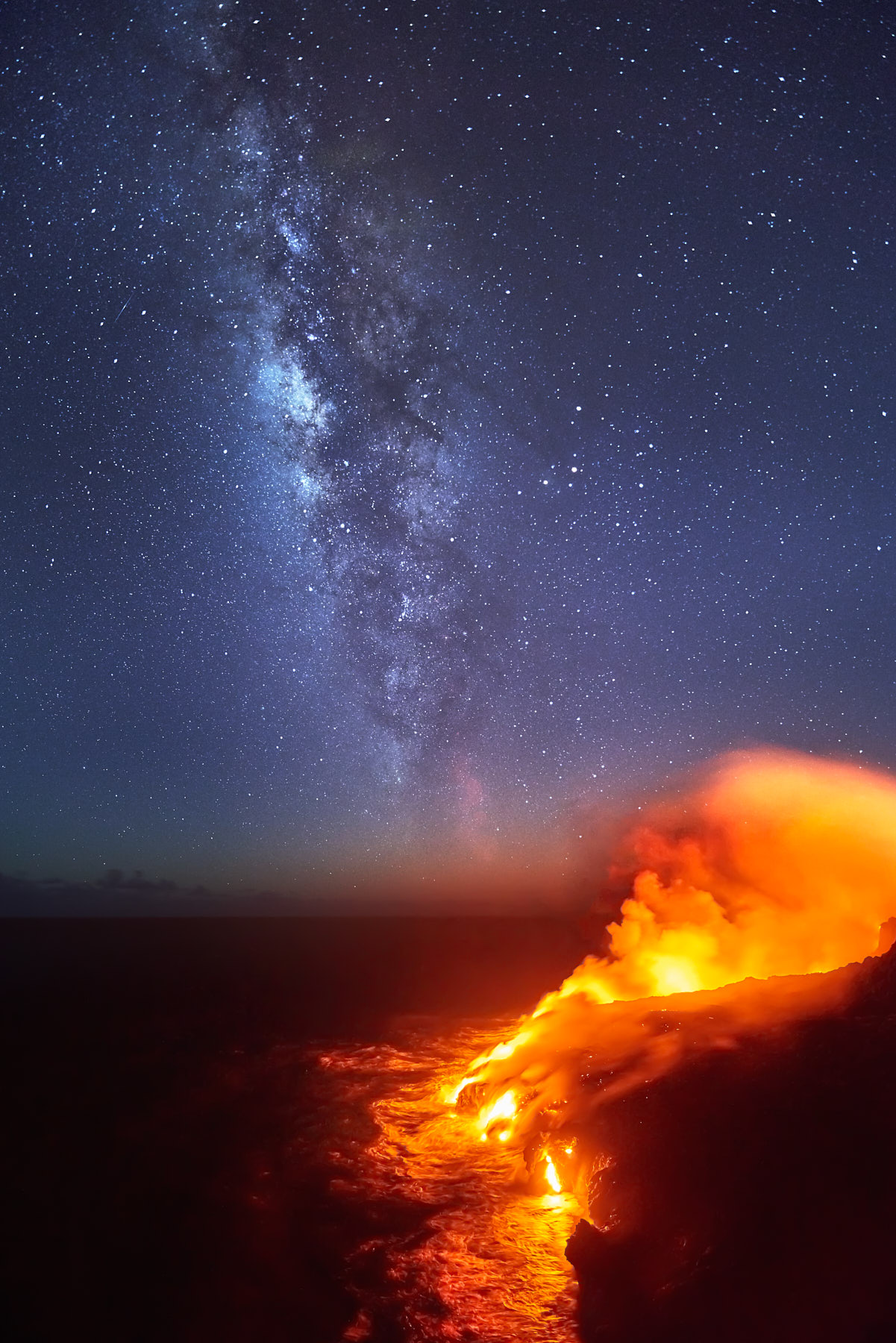
One of the most epic ideas I had for an image and it really just kind of happened so I had to figure out a way to pull this one off. If you look closely, you can also see the international space station in the upper corner of this one too
Collector's Edition of 50
When to See Meteor Showers on Maui
According to the AstroRover website, the Milky Way Galactic Center is visible in April starting at 11:20 p.m., in May at 9:22 p.m., and in June and July starting at 8:32 p.m. So if your Maui stargazing bucket list includes seeing the Milky Way, book your trip from April to August. This is when the Milky Way galactic center is most visible from Maui, appearing for 4+ hours each night in all its glory.
The two best meteor showers to view on Maui are the Perseids and the Geminids.
- The Perseids meteor shower peaks around August 12–13 with up to 200 meteors per hour
- The Geminid meteor shower peaks around December 13-14 with up to 120 meteors per hour.
Moon Phase Matters
If at all possible, try to schedule your Maui stargazing adventure at times when the moon will not be full; this will help to enhance the visibility of the stars and other celestial objects. Also, keep an eye on the weather forecast to avoid cloudy nights.
Tip #2: Find the Ideal Location
To have the best Maui stargazing experience possible, you'll want to find the darkest areas on the island. Higher elevations also provide extra clarity.
Here are my favorite Maui stargazing locations:
Haleakalā Summit (10,023 feet)
The summit of Haleakalā National Park is hands down the best stargazing in Hawaii, and one of the best in the world. At over 10,000 feet elevation, you're above the clouds with virtually zero light pollution. On a clear night, the Milky Way is visible to the naked eye.
The park entrance fee is $30 per vehicle (valid for 3 days), and the drive takes about 1.5 hours from most resort areas. Be prepared for the cold. Temperatures can drop to 30–40°F at night, even when it's 80°F at sea level.
Secret Beach (Makena Cove)
Secret Beach in Makena is one of my favorite locations for combining Maui's coastal beauty with incredible night sky views. This small, secluded cove offers dark skies away from resort lighting, with the added magic of hearing waves while you stargaze. The volcanic rock formations and pohutukawa trees create dramatic silhouettes against the Milky Way.
Honomanu Bay (Road to Hana)
If you're staying in Hana or exploring the east side of the island, this secluded black sand bay offers surprisingly dark skies despite the lower elevation. The lush tropical surroundings and sound of waves create a completely different stargazing atmosphere than the stark volcanic summit.
Tip #3: Come Prepared
You may be perfectly comfortable in a t-shirt, shorts and sandals during the warm days on Maui, but at night our temperatures can drop to the point where you’ll want to dress more warmly. To make your Maui stargazing experience pleasant and not chilly, dress in, or bring along extra layers including a sweatshirt and long pants.
Also, pack blankets or chairs, and if you have them, binoculars and/or a telescope. If you plan to head off the beaten track at any point during the evening, be sure to pack a flashlight and wear sturdy shoes. A few snacks and some beverages like water, coffee and/or cocoa are also great additions to your Maui stargazing.
Essential items:
- Warm clothes & sturdy shoes
- Blankets & chairs
- Flashlight
- Snacks & drinks
- Fully charged phone
- Astronomy app (to identify constellations)
- Camera & tripod (if taking photos)
- Binoculars / telescope (if possible)
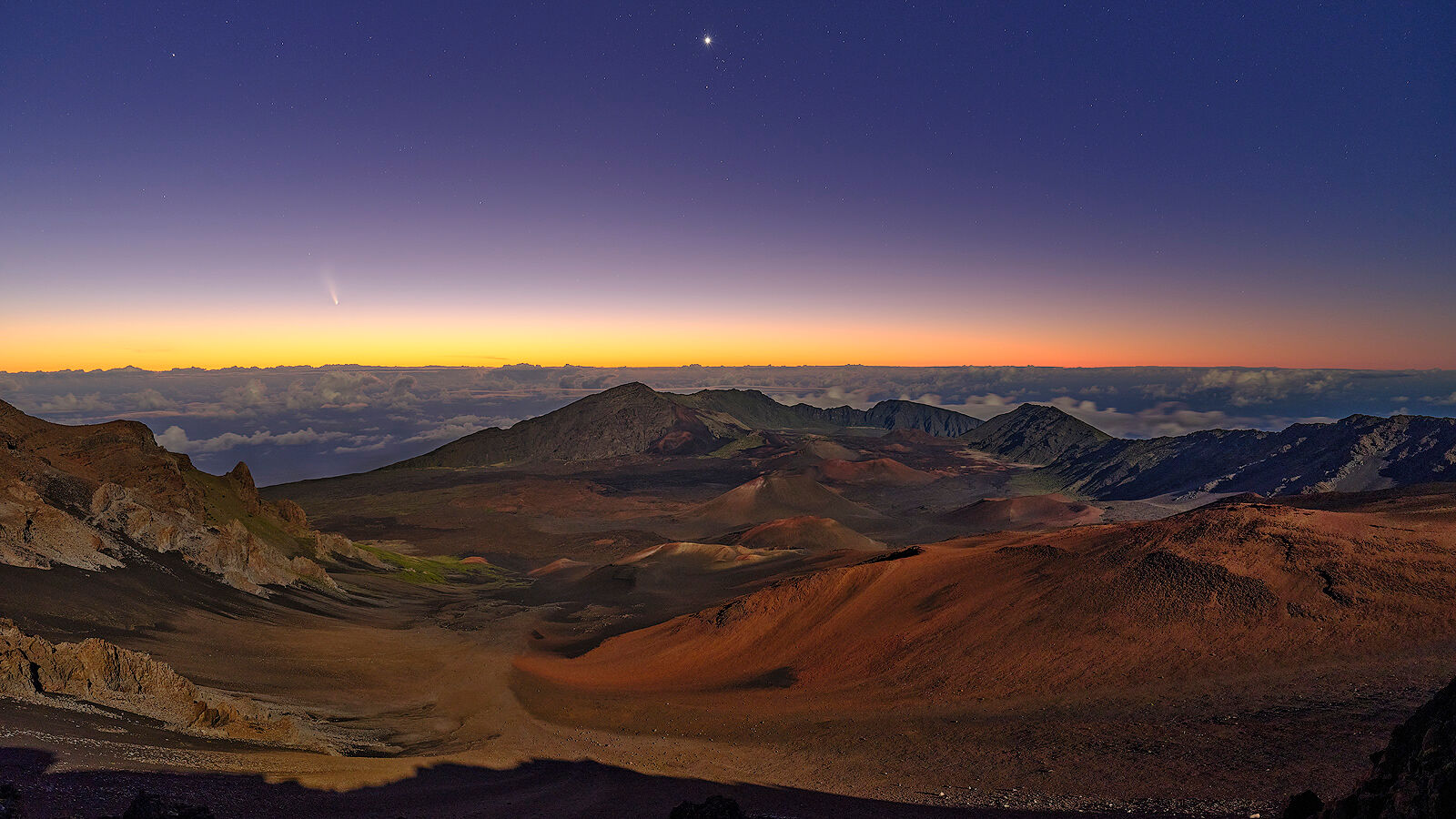
This was such a fun image to capture as comet Neowise is visible just over the horizon right before sunrise at Haleakala crater. A full moon is behind me here providing the lighting for the crater in a shot that just kind of all came together. Comet Neowise will not visit us again for 6800 years so very fortunate to have captured this
Collector's Edition of 50
Tip #4: Bring Some Night Sky Knowledge
To help identify the celestial objects you see during your Maui stargazing adventure, you might want to download a stargazing app onto your phone. Vito Technology has posted a helpful review of 20 of the top stargazing apps, many of which are free to download, and available for both iOS and Android.
Also, if you are hoping to see a meteor shower, try to do some research ahead of time to know where in the sky you should look for the shooting stars. You can also look up how to find well-known constellations like the Big Dipper, Orion’s Belt, and others.
Book a Stargazing Tour!
Want to use an amazing telescope in one of the best places in the world to observe the cosmos? Book a Tour Here
Tip #5: Night Sky Photos
Although it is possible to capture photos of your Maui stargazing experiences on your phone, it can be challenging to get decent night sky images. A DSLR camera as well as a tripod and a wide-angle lens, are ideal for astro photography.
Pack a good dose of patience as well, as getting great photos of the nighttime sky—especially fleeting objects like shooting stars—can challenge even more experienced photographers. In general, you’ll want to use a wide aperture, and slow shutter speed, and you will probably find it takes a lot of trial and error to find the best settings for your shot.
If you find that taking photos is more frustrating than enjoyable, no worries. There are plenty of beautiful astrophotography prints in my online collection that were taken from locations around Maui, including the stunning Makena Milky Way.
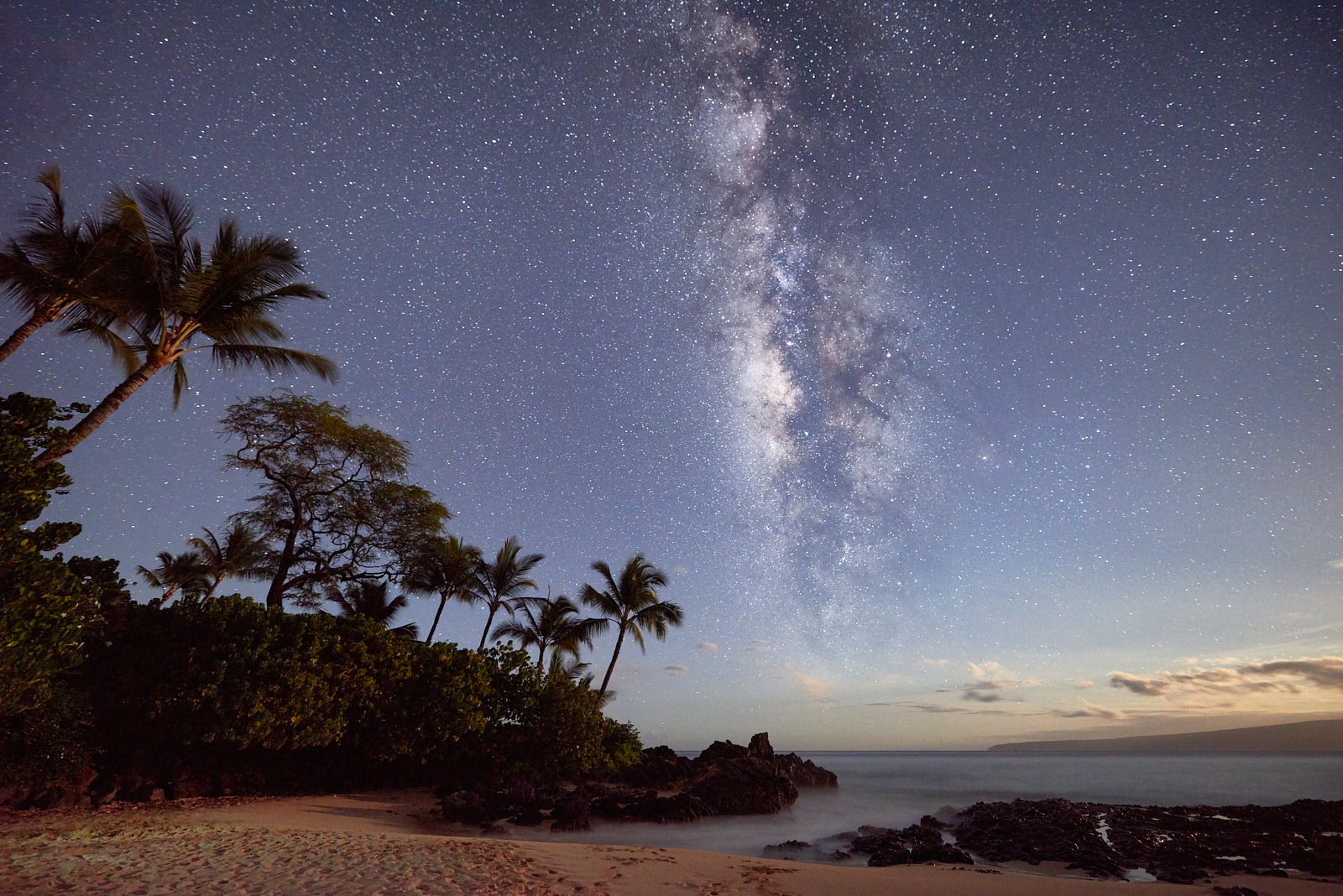
The Milky Way Galaxy rises over Makena Cove here on the island of Maui. Always appreciate how small we all are with an image like this
Collector's Edition of 50
What You'll Actually See in Maui's Night Sky
On a clear night from a dark location, the Maui night sky is absolutely packed with celestial wonders. Here's what you can expect to see:
With Your Naked Eye:
- The Milky Way galaxy stretching across the sky like a luminous river (most dramatic April–August)
- Major constellations including Orion, the Big Dipper, Scorpius, and the Southern Cross
- Visible planets like Jupiter, Saturn, Mars, and Venus
- Meteor showers with dozens of shooting stars per hour during peak events (Perseids in August, Geminids in December)
- Thousands of individual stars—far more than you'd see from even rural mainland locations
With Binoculars or Telescope:
- The Andromeda Galaxy (our nearest major galactic neighbor)
- The Orion Nebula (a stellar nursery where new stars are forming)
- Jupiter's four largest moons
- Saturn's iconic rings
- Star clusters like the Pleiades (Seven Sisters)
- Nebulae and distant galaxies
Hawaii Stargazing You Won't Forget
Whether you're here for a week or you call Maui home, I hope you take the time to look up. The island's beaches and waterfalls are incredible, but the night sky? That's something you won't find just anywhere.
It's a breathtaking and beautiful reminder that we're all part of something much bigger.
If you'd like to bring a piece of Maui's night sky home with you, I've spent years capturing these moments in my night sky photography collection—from the Milky Way over Makena to meteor showers above Haleakalā. Each print is a reminder of what makes these islands so special.
If you’d like these moments to find you again, quietly and unannounced, you’re welcome to join my email list. I share new night sky prints, stories from behind the lens, and the occasional special offering there. Think of it as a way to keep a piece of Maui’s sky close, wherever you are.
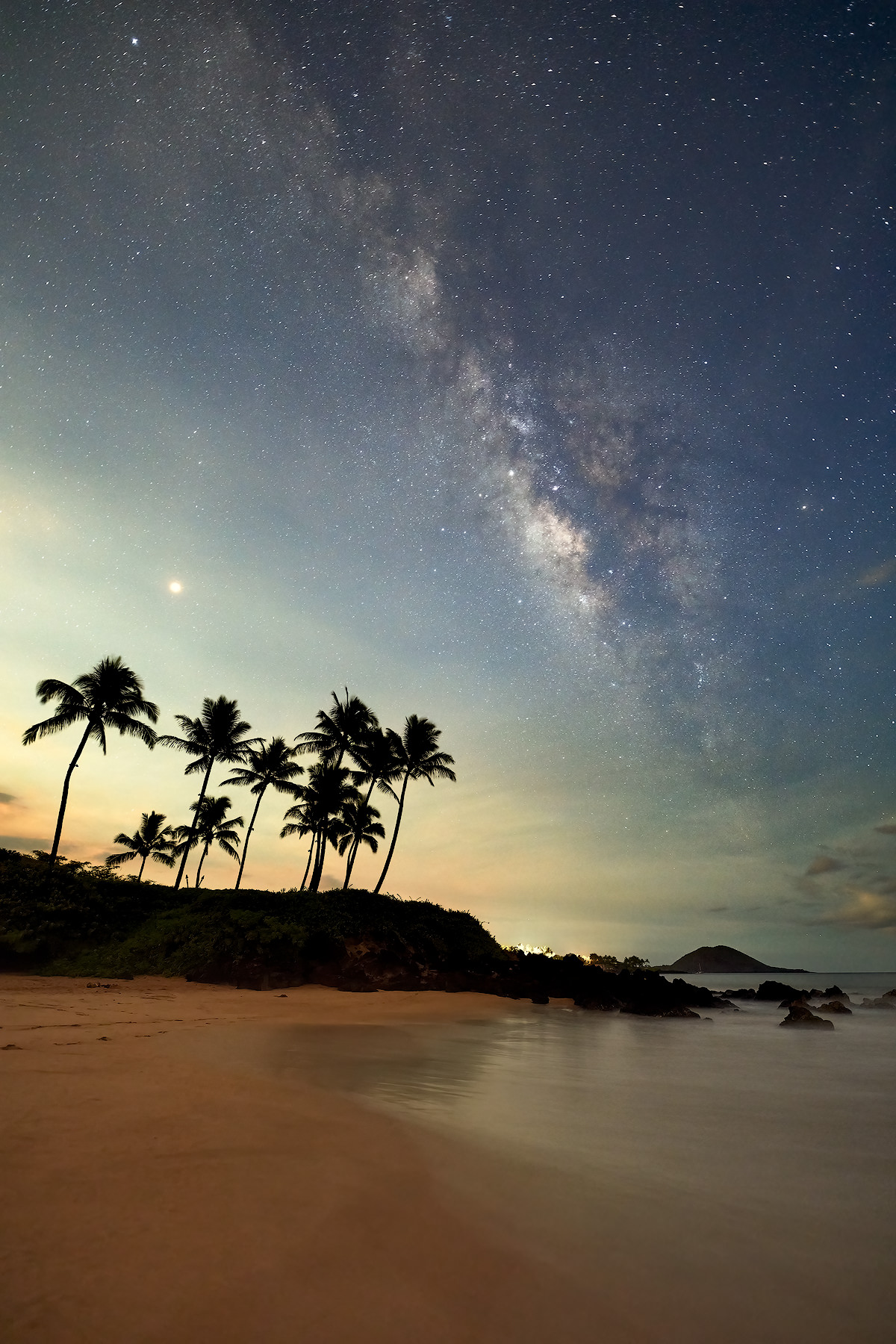
So many elements just happened to come together for this shot. Some may think is is multiple images but it's just one shot. The moon was very low on the horizon and we also had fires in central Maui which created a bit of a haze. The haze in turns gets illuminated by the moonlight and it really brings this scene all together into an infinite paradise.
Collector's Edition of 100